Key takeaways
- Your cabinets can be refaced if the boxes are solid.
- Refacing replaces the doors, the drawer fronts and the veneer on the face frames, and the boxes stay on the wall.
- Check the sink base for soft or swollen wood, lay a straightedge across the shelves, push on the face frames, and decide whether you still like the layout.
- A damaged sink base, loose face frames or a layout you want to change point to new cabinets.
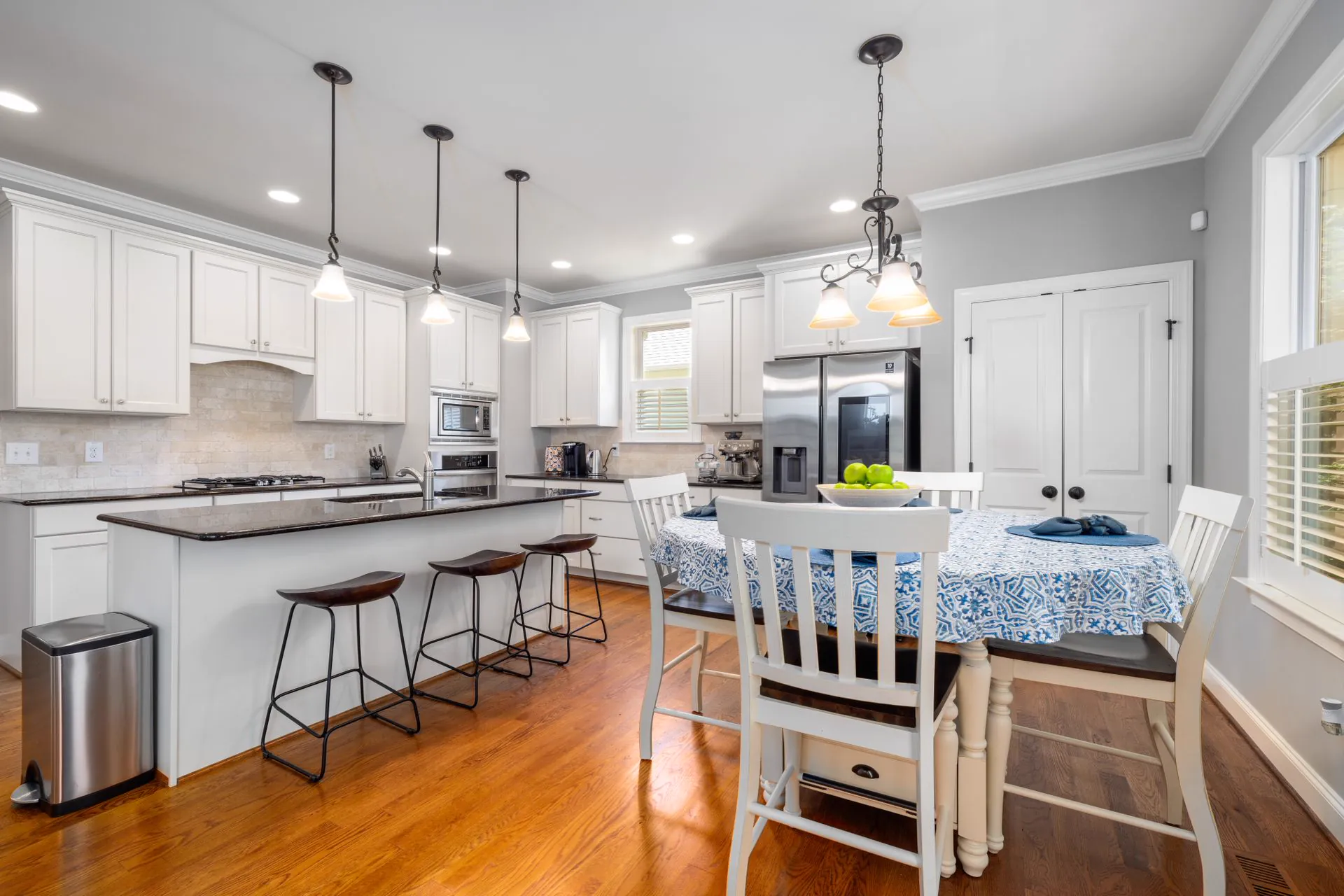
The oak cabinets in your kitchen went in with the house, or in a remodel around 1995, and the doors look tired. The finish has worn through by the handles, and the door under the sink won't stay shut. You've heard refacing is the way to fix that without tearing the kitchen out, and you want to know if your cabinets qualify. The answer depends on the cabinet boxes, the part nobody looks at, and you can check them yourself before anyone comes out to measure.
What refacing replaces, and what stays
A kitchen cabinet is a box (two sides, a back, a bottom and the shelves) with a face frame on the front. The face frame is the wood rectangle the doors hang on. Our cabinets page puts refacing in one line: if your cabinet boxes are solid, refacing replaces the doors, the drawer fronts and the veneers, for a new look in a fraction of the time and cost of a full tear-out.
In practice, the old doors and drawer fronts come off and new ones go on. The face frames get covered in new veneer, a thin sheet glued over the old surface so the frames match the new doors. The boxes stay screwed to the wall, and the countertop stays on top of them.
That makes refacing a new front on an old box. On a sound box it's a good trade, since the countertop and the sink plumbing stay where they are. On a box that's swollen, sagging or pulling apart, the new veneer goes on over the problem and the problem is still there in five years.
What you need for the check
- A flashlight (the one on your phone works)
- A yardstick, a 2-foot level or any straight board
- The sink cabinet emptied out, which takes longer than the check
- About five minutes once it's empty
Step 1: Check the floor of the sink cabinet
The sink base is the box most likely to be damaged, because it's the one with water running through it. A slow drip at the trap or a supply line can go on for months behind the dish soap before anyone notices.
- Shine the flashlight on the cabinet bottom, the panel you set things on. Look for dark rings, white water lines, or a surface that has bubbled or lifted.
- Press with your thumb at the back, under the trap and along the front edge. It should feel as hard as the bottom of the cabinet next to it.
- Look at a cut edge around the pipe holes. Pressed wood chips mean particleboard. Thin layers stacked like a cake mean plywood.
- Smell it with the door open. A musty smell means something under there is damp or growing mold.
Particleboard is the one to worry about. It swells when it takes on water and doesn't shrink all the way back when it dries. In a 1973 Forest Products Journal study, commercial particleboard cycled up to 93 percent humidity swelled 5.5 to 15 percent in thickness, and a third to half of that swelling stayed after the air dried out. That was damp air. A leak under a sink is water sitting on the board.
The EPA says to dry water-damaged areas within 24 to 48 hours to prevent mold, and that porous materials may have to be thrown away once they get moldy. A cabinet bottom under a dripping trap never gets those 48 hours. It's the same slow process that rots the subfloor next to a bathtub, on a smaller piece of wood.
A firm, flat bottom with an old stain is fine. A bottom that gives under your thumb, has swollen at the edges or is lifting at the seams is a damaged box. Whatever you decide about the cabinets, get the leak fixed first.
Step 2: Lay a straightedge across the shelves
- Pick the widest wall cabinet, the one with the plates in it, and take everything off one shelf.
- Set the yardstick on edge across the front of the shelf, end to end, and look at the gap under the middle.
- Look at the pins or clips the shelf sits on. Check whether they're tight in their holes or whether the holes have crumbled.
For a sense of what counts as sag, the cabinet industry's own test standard, ANSI/KCMA A161.1, loads new shelves with 15 pounds per square foot for seven days. To pass, a shelf can't bend more than a sixteenth of an inch per foot between its supports, and never more than a quarter inch. That allows a 3-foot shelf about three-sixteenths of an inch under load, so one that sags half an inch with nothing on it is well past what a new shelf has to pass.
A sagging shelf on tight pins is a shelf problem. A shelf is a loose part, and a new one is a small fix. Side panels where the pins have torn out, or sides that bow outward at the middle, are a box problem.
Step 3: Push on the face frames
- Grab the face frame where two pieces meet, at a corner or beside a drawer, and push and pull. Watch for a gap opening at the joint.
- Look down the line where the face frame meets the cabinet side. A crack running the height of the cabinet means the frame is pulling off the box.
- Open each door and wiggle it. Note any hinge whose screws spin in their holes.
- Look at the top of each wall cabinet. A gap between the back of the cabinet and the wall means the screws holding it up are letting go.
The face frame carries the new veneer and the new doors, so it has to be tight and flat. A joint that moves under your hand will move under the veneer, and the veneer can crack along that line. New doors hang from the same frame, so stripped screw holes there matter too.
A wall cabinet pulling away from the wall comes first. Empty it and have it fastened before you decide anything else. A cabinet full of dishes is heavy.
Step 4: Stand in the doorway and judge the layout
Refacing keeps the boxes, and keeping the boxes keeps the layout. The sink, the range and the refrigerator stay where they are, and so does every cabinet. Before you spend money on new fronts, decide whether you like the kitchen they're attached to.
- Do you use the corner cabinet, or has it held the same roasting pan since 2004?
- Is there a cabinet over the refrigerator you need a step stool to reach?
- Do you want an island, a pantry wall, or the dishwasher on the other side of the sink?
- Will the next refrigerator you buy fit the opening you have?
Some of those answers live inside the boxes you have. We fit new or existing cabinets with organizers: a lazy Susan for the corner, pull-out shelves that bring the back of a deep base cabinet out to you, and a trash and recycling pull-out next to the sink. If your complaints are about reaching things, organizers in the old boxes may answer them. If your complaints are about where things are, new doors won't move anything.
Reading what you found
| What you found | What it means | Likely call |
|---|---|---|
| Firm sink base, flat shelves, tight frames, a layout you like | Sound boxes | Reface |
| An old stain on a sink base that's still firm | A leak that dried out | Reface, after the leak is fixed |
| A sagging shelf on tight pins | A tired shelf | Reface, with a new shelf |
| A soft or swollen sink base, face frames pulling loose, or sides torn at the shelf pins | Damaged boxes | Replace |
| A layout you want to change | The boxes are in the wrong places | Replace |
When new cabinets are the better call
The answer on our cabinets page is short: if the boxes are worn or damaged, full replacement is the better choice, and we'll recommend what fits your kitchen. In the check above, that means a sink base that's soft or swollen, face frames separating from the boxes, side panels bowed or torn at the shelf pins, or a layout you want to change.
Refacing is a good job on good boxes, and nobody should sell you new cabinets you don't need. A 1990s oak kitchen in a West Chester two-story with a dry sink base and tight frames is the kitchen refacing was made for. A 1968 Anderson Township ranch with a sink base that's been wet for ten years is a different conversation.
When we replace cabinets, the new ones are all-plywood boxes with 3/4-inch adjustable shelves, 3/4-inch solid wood doors on 3/4-inch solid hardwood face frames, dovetail drawers, soft-close hinges and slides, and metal corner brackets that keep each box square. The specs are on the cabinets page. New base cabinets mean the countertop comes off, so plan to make the countertop decision at the same time.
What our consultant checks
A Bulldog design consultant measures the kitchen, walks you through door styles and finishes, and tells you whether they'd reface or replace and why. The quote is written and comes after the measuring. If refacing fits, they'll say so.
Many kitchen updates take a few days. A full kitchen with new cabinets takes longer, and your project coordinator gives you a schedule before work starts. Our own crews do the installation, and the work and the products carry a lifetime warranty for as long as you own the home. Financing is available on approved credit. The three questions to ask a contractor before a deposit were written about bathrooms, and they work the same way on a kitchen quote.
Do the check this weekend and write down what you find. Then call (513) 657-3750 or request an estimate, and have the notes on the counter when the consultant opens the sink base.
A new-looking kitchen in days, not months walks through every part of the kitchen in order: what to keep and what to replace.