Key takeaways
- When the cabinet boxes are sound, keeping them is what lets the rest of the work happen in days, not months.
- Check the boxes first, then decide on new doors and drawer fronts, then the countertops, with the sink and faucet going in alongside them.
- The backsplash goes after the counters, or on its own if the counters are staying, and organizers fit into the boxes you kept.
- Many kitchen upgrades are finished in as little as three days, and a full kitchen with new cabinets takes longer.
The kitchen in a 1972 split-level in Montgomery tends to look the same. Someone put oak doors on it in the 1990s, the laminate counter has a burn mark by the stove and a ridge at the seam by the sink, and the faucet drips if you don't lean on the handle. The cabinets themselves still hang straight on the wall. That last part decides how long the job takes.
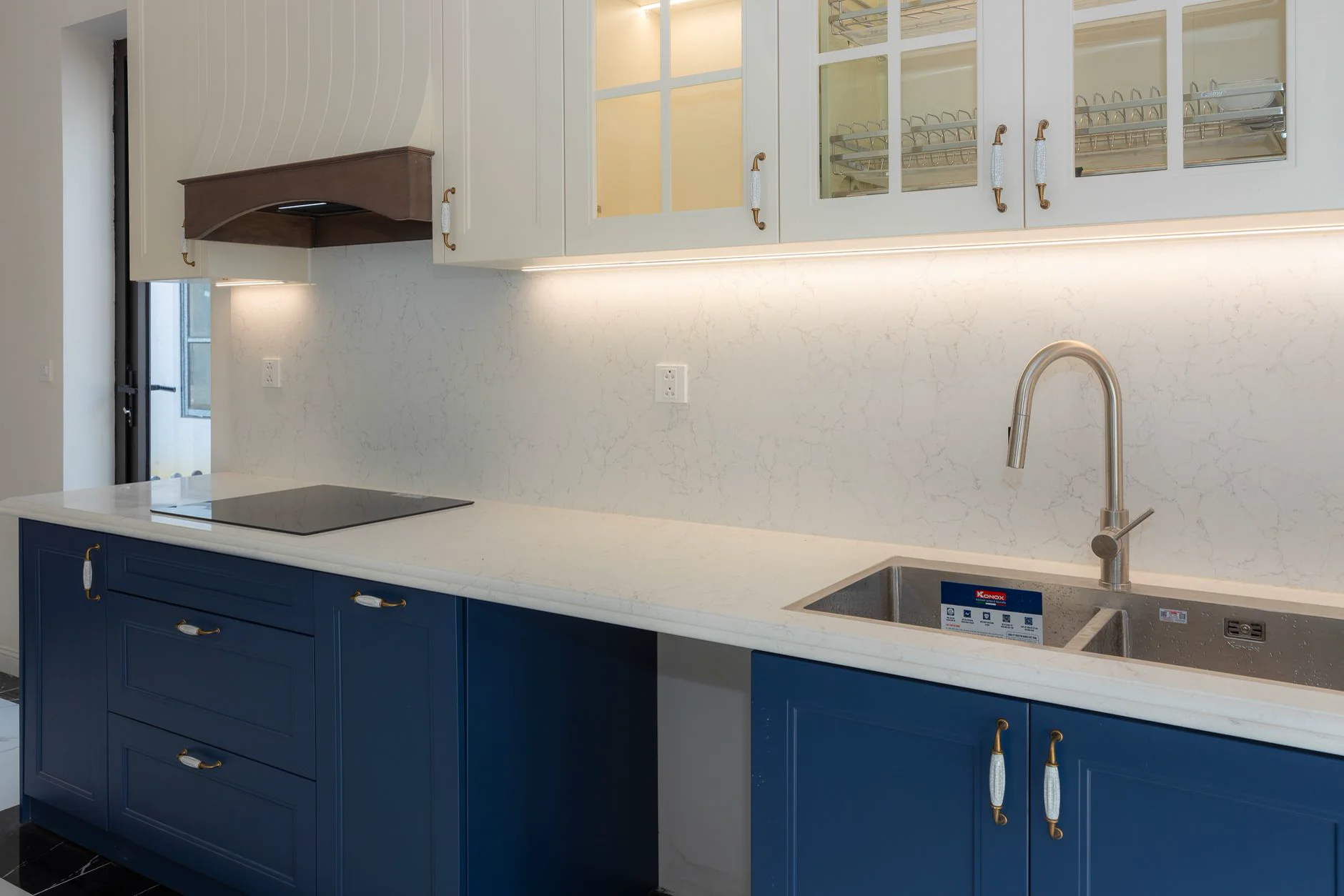
If the cabinet boxes are sound, you can keep them and change almost everything you look at: the doors and drawer fronts, the countertops, the sink and faucet, the backsplash, and what's inside the cabinets. Many kitchen upgrades are finished in as little as three days. A full kitchen with new cabinets takes longer, because the boxes come off the wall and everything that sits on them comes off too. Keep what's sound, replace what's worn, and do it in an order where nothing you put in this year has to come out next year.
Keep what's sound, replace what's worn
A kitchen goes together in layers. The cabinet boxes carry the countertop. The countertop holds the sink and sets the bottom edge of the backsplash. The doors hang on the boxes, and the organizers mount inside them. Change a lower layer and everything above it gets disturbed, so the order of decisions follows the order of the layers:
- The cabinet boxes: keep or replace.
- The doors and drawer fronts: reface, refinish or leave alone.
- The countertops: quartz, granite or solid surface.
- The sink and faucet, which go in with the counter.
- The backsplash, after the counter or on its own.
- Organizers, inside the boxes you kept.
You don't have to do all six. The question at each step is whether the thing in front of you is worn out or only out of style, and whether changing it later would mean tearing out something you paid for this year.
| The job | What you keep | What changes | How much of the kitchen is out of use |
|---|---|---|---|
| Refacing | Cabinet boxes, counters, sink | Doors, drawer fronts, face-frame veneer | Cabinets emptied and doors off while the crew works |
| New countertops | Cabinet boxes and doors | Tops, with the sink and faucet reset or replaced | Counters cleared, sink out of service for part of the job |
| New backsplash | Counters and cabinets | The wall between counter and uppers | Counters cleared along that wall |
| Organizers | Everything you see | The inside of the base cabinets and drawers | One cabinet at a time |
| New cabinets | The room and the appliances | Boxes, doors, tops, sink and backsplash | The whole kitchen, for longer |
Start with the cabinet boxes
Every other decision sits on this one. Refacing, new counters and organizers all assume boxes that are square, solid and attached to the wall. A box that isn't will carry its problem into whatever you put on it.
The sink base is where boxes fail first. A slow drip from a supply line or the dishwasher hookup soaks the floor panel, and particleboard that has swelled rarely goes back flat. The Environmental Protection Agency says to dry water-damaged areas within 24 to 48 hours to prevent mold growth, and a leak nobody saw for months never got that chance. The soft floor under your kitchen sink covers the four places those leaks start and when a sink base can be repaired or has to go.
The rest of the check takes a flashlight and a straightedge. Press on the floor of the sink cabinet, lay the straightedge across the shelves, push on the face frames to see if they've pulled loose from the boxes, and then stand in the doorway and decide whether you still like where things are. Can my cabinets be refaced? walks through each step and what each result means.
Two answers point away from keeping the boxes: damage you can't fix in one cabinet, and a layout you want to change. If the dishwasher is in the wrong place or you've wanted an island for 20 years, refacing the boxes you have locks in the layout you don't like. If the boxes are worn or damaged, we'll recommend full replacement.
New doors and drawer fronts on the boxes you kept
Once the boxes pass, the doors are the biggest change you'll see for the least disruption. Refacing replaces the doors, the drawer fronts and the veneer on the face frames, and the boxes stay on the wall with your counters still sitting on them. Refinishing keeps the doors you have and changes their finish. Paint is the one you can do yourself over a few weekends, with the catch that oak's open grain shows through unless someone fills it first. Reface, refinish or paint compares the three on a 1990s oak kitchen, grain and all.
If you reface, you're picking a new door, and that's two decisions:
- The door style. Shaker fits the widest range of older houses. Flat doors suit a 1960s ranch, and raised panel suits a 1990s two-story. Shaker, flat or raised-panel doors goes house by house and covers which doors hold grease in the corners.
- The finish. Painted doors give you one even color and show a chip when you get one. Stained doors let the grain hide small dings. Painted or stained cabinets in a kitchen that cooks every day covers wear near the range, and two-tone kitchen cabinets covers which splits of color age well and which tie the room to a year.
Bulldog offers full replacement or refacing, with shaker, flat-panel and raised-panel doors (and glass-front uppers) in painted, stained and two-tone finishes. New boxes are all plywood, with 3/4-inch solid wood doors and face frames, dovetail drawers, and soft-close hinges and slides. Our cabinets page shows the door styles.
Countertops on the cabinets you kept
The counter is the next layer up, and it's where most older kitchens are worst off. An old laminate top is a thin plastic sheet glued to particleboard, so a burn goes through the pattern and a swollen seam by the sink means the core has taken on water. Laminate countertops in an older kitchen covers when a patch still makes sense and what replacing the top involves.
A new stone or solid-surface top asks more of the cabinets under it than laminate did. Cambria, a quartz maker, says in its installation requirements that the cabinets must not be out of plane more than 1/8 inch for every 8 feet, and that a top over an appliance opening like a dishwasher needs vertical support on three sides. Cambria also says the tops get shimmed onto the same plane at installation, so a small dip is part of the job. A box pulling away from the wall is not. New countertops on your old cabinets explains what the boxes have to carry and when to replace them instead.
Then the material. Granite stands up well to heat. Quartz needs no sealing and resists stains. Solid surface is the one you can sand back when it scratches. Quartz, granite or solid surface sorts them by the habit you won't change, like where the hot pan lands.
Bulldog fabricates and installs all three. We make a digital template of your existing layout for a tight fit before the tops are cut, and you pick the edge profile. The countertops page shows the materials and colors.
The sink and faucet go in with the counter
A new countertop means the sink comes out anyway, so this is the easiest moment to change it. The choice that matters most is how the sink meets the counter. A drop-in sink sits on its own rim on top of the counter and works with almost any top. An undermount sink hangs under the counter, so you wipe crumbs and water straight into the bowl with no rim to clean around, and it needs a top with a solid edge at the cutout, such as granite, quartz or solid surface. Undermount or drop-in sink covers cleaning, where the water goes and which one is easier to replace later.
The faucet is a smaller decision with a bigger effect on your hands. A single lever is easier to work than two knobs if your hands are stiff, since you push it instead of gripping and twisting. Count the holes under your sink before you shop, because the new faucet and the new counter have to agree. Choosing a kitchen faucet you won't fight with goes through six choices, from spout height to the finish that hides water spots.
Bulldog installs undermount, farmhouse, drop-in and double-bowl sinks, and pull-down, single-handle, two-handle and touchless faucets, in finishes chosen to match the cabinet pulls.
If the counters are staying, a new sink and faucet can still go in on their own. A drop-in is the usual pick on an old laminate top, since it works with almost any counter.
The backsplash after the counters, or on its own
The backsplash goes on after the countertop because its bottom edge sits on the counter. Put a new backsplash in this spring and replace the counter next spring, and the bottom row may need new caulk or trimming once the new top goes in, or more if the new top's back edge doesn't line up.
If your counters are staying for years, a new backsplash on its own is a fair job. The deciding detail is the back edge of the counter. A laminate top with a curved splash built into it keeps that splash, and a separate splash strip can come off. Outlets and switches usually need to come forward to meet the new wall surface. A new backsplash without new countertops goes through each of those steps.
Bulldog installs ceramic, porcelain and glass tile, natural stone, mosaics and grout-free panels, coordinated with the counters and cabinets you have. Your project coordinator gives you a detailed schedule before work starts.
Organizers in the boxes you kept
Organizers are the one change that doesn't depend on anything else. They mount inside the boxes, so they work in new cabinets or the ones you kept, and they're the change you'll notice most on a Tuesday night. The Centers for Disease Control and Prevention says 1 in 4 older adults report falling every year. The deep base cabinet and the top shelf are the two places in a kitchen where you kneel and climb.
The ones worth adding bring things out to you:
- Pull-out shelves in the deep base cabinets, so you stop kneeling.
- A trash and recycling pull-out in the cabinet next to the sink.
- A lazy Susan or swing-out baskets in the corner cabinet.
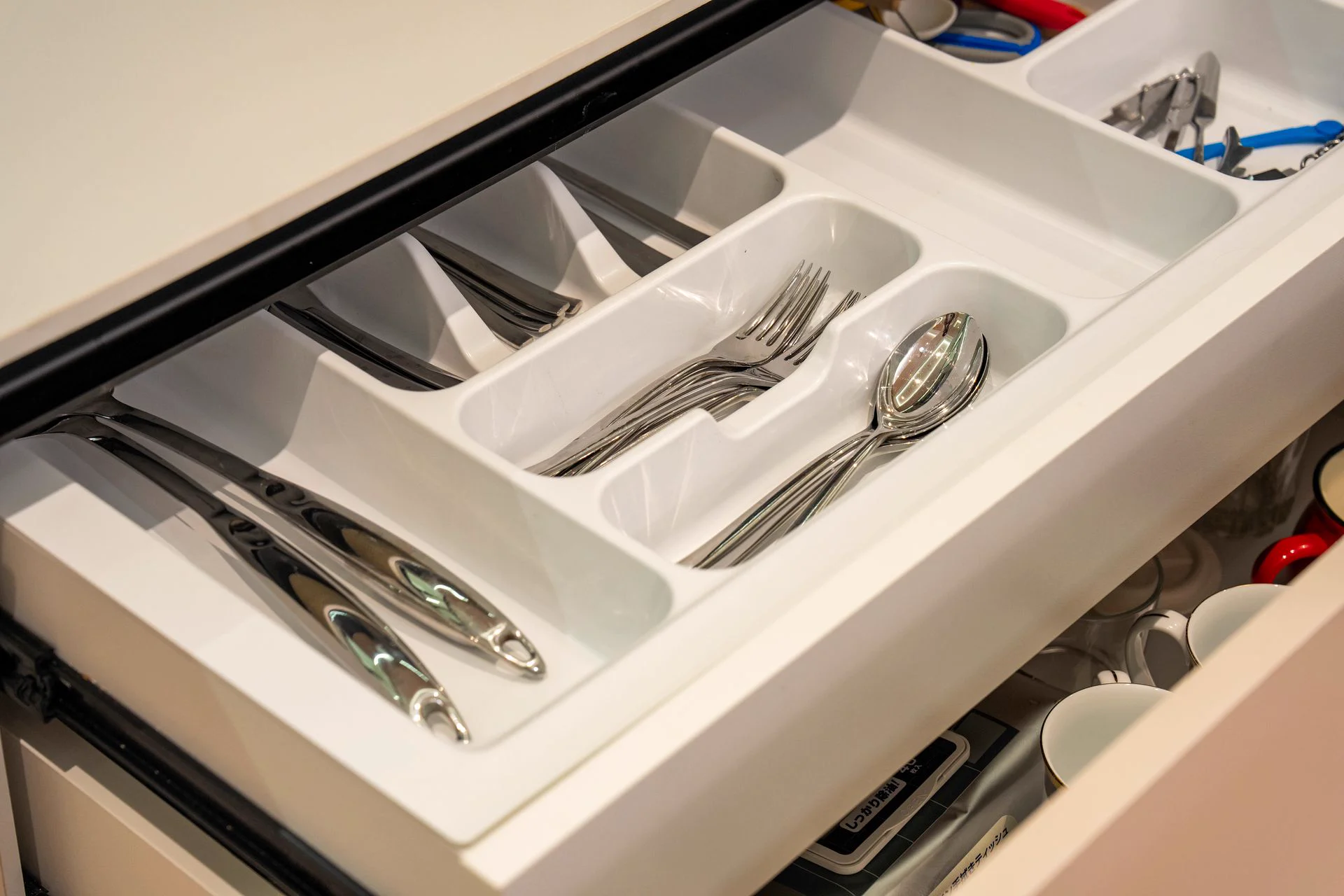
- Drawer inserts for cutlery, utensils and spices, with soft-close slides.
Seven kitchen cabinet organizers for the next 15 years covers each one and how to sort the upper shelves by what you use every day. If you're refacing, add the organizers on the same job, while the cabinets are already empty.
When the whole kitchen should go
Keeping the boxes is the fast route, and it isn't always the right one. New cabinets make more sense when:
- The sink base or another cabinet has water damage that a new floor panel won't fix.
- Face frames have pulled away from the boxes, or the boxes have pulled away from the wall.
- You want to move the sink, the dishwasher or the range, or add an island.
- The cabinets are the wrong height or depth for the counters and appliances you want.
That's a bigger job. The old cabinets, counters, sink and backsplash all come out, and the kitchen is out of use for longer than any of the other jobs in the table, and your project coordinator gives you a detailed schedule before work starts.
Living in the kitchen while the work happens
For the smaller jobs, most of the kitchen stays usable most of the time. Plan for these:
- Refacing: empty the cabinets the crew is working on. The counters and sink stay in place.
- Countertops: clear the counters and empty the sink base. The sink is out of service for part of the job, so plan a few meals that don't need it.
- Backsplash: clear the counters along that wall and move the small appliances.
- Organizers: empty the cabinet that's getting one.
Bulldog's own crews do the installation, the same people who came for the consultation. The products and the work carry a lifetime warranty for as long as you own the home.
Where to start
Start with the box check. If the sink base is dry and the shelves lie flat, most of your options stay open. If the sink base is wet or soft, fix the leak first and let the cabinet dry out before you decide anything else.
Then write down the three things in the kitchen that bother you most. Your answers sort the jobs for you. A swollen seam and a burn mark point to the counter. Doors you're tired of point to refacing. Kneeling to find a pot lid points to organizers.
A Bulldog design consultant comes to your kitchen, measures, brings samples of colors and finishes so you see them in your own light, walks you through the options and recommends what fits. We can show you the new kitchen in 3D before anything is ordered, and you get a written quote after the measuring. What happens at a kitchen design consultation covers the visit and what to have ready. Financing is available on approved credit; the financing page has the details, and Current Promos lists the offer for full kitchen remodels.
See every kitchen service on one page, or call (513) 657-3750 to book the free in-home estimate.