Key takeaways
- The organizers worth adding are the ones that bring things out to you, so you stop kneeling at the base cabinets and climbing to the top shelf.
- Pull-out shelves, a trash and recycling pull-out, a pull-out pantry and a lazy Susan in the corner cover the lower cabinets.
- Drawer inserts and soft-close hardware make the drawers you use every day easier to work.
- In the uppers, keep daily items on the lowest shelf, and use the top shelf and the cabinet over the refrigerator for things you need a few times a year.
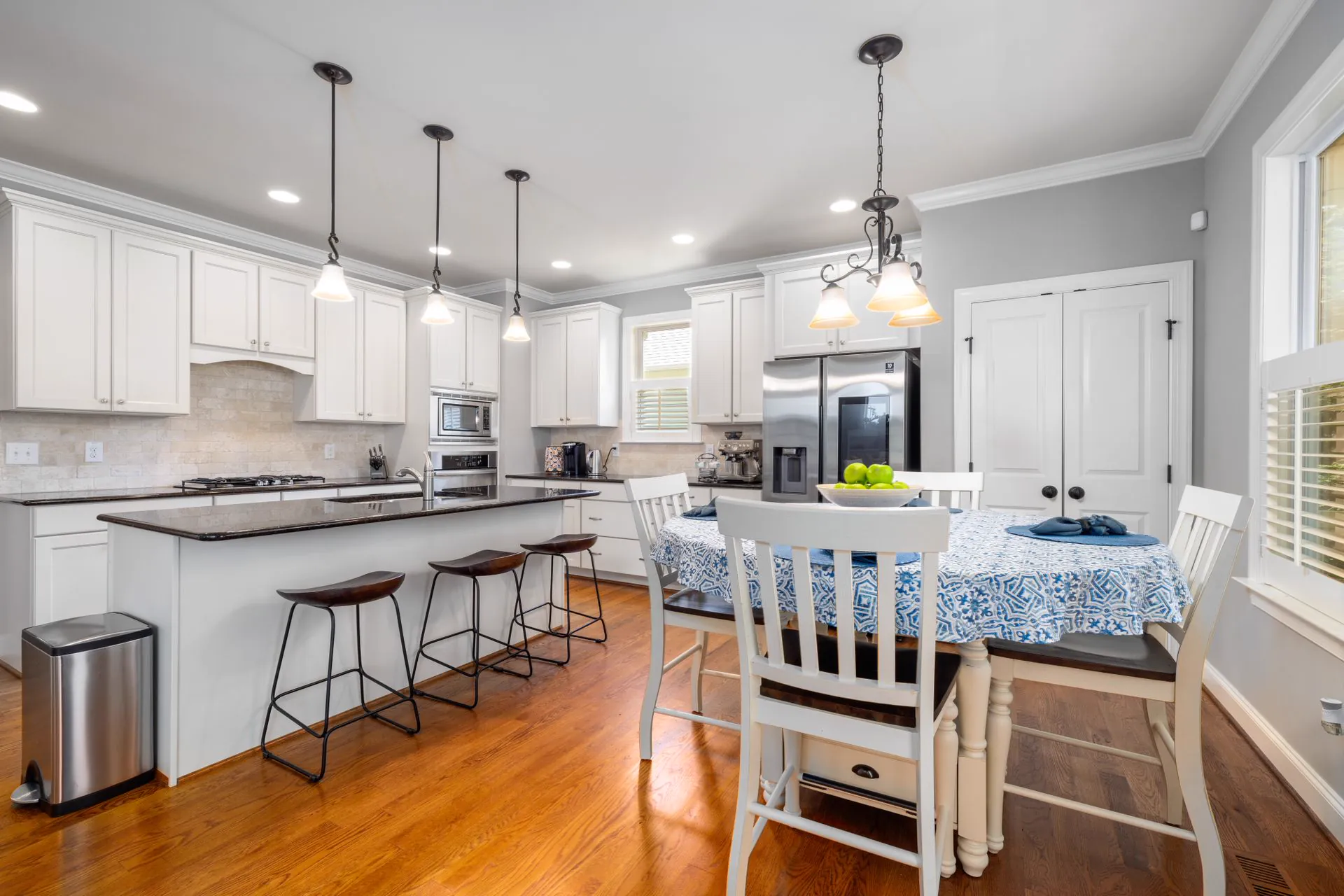
The big stockpot lives at the back of the corner cabinet, so getting it out means kneeling on the kitchen floor with a flashlight. The everyday glasses are on the second shelf of the upper cabinet, and the platter you use at Thanksgiving is over the refrigerator, where it takes a step stool and a held breath. In a 1920s Tudor in Hyde Park or a 1960s ranch in Anderson Township, that's how the kitchen was built. Kitchen cabinet organizers change how you get to what's inside the boxes, and most of them fit into the cabinets you already have.
These are the seven we'd put in a kitchen meant to work for the next 15 years, in the order we'd do them. Each one fixes one motion: kneeling, reaching to the back, climbing or digging.
How we picked these kitchen cabinet organizers
We kept to the organizers we fit into kitchens ourselves, and we ranked them by how often they save you a kneel or a climb. Nothing here was tested in a lab. The reach numbers come from the federal accessibility standards, and the fall advice comes from the Centers for Disease Control and Prevention.
The CDC says about 1 in 4 adults 65 and older report a fall every year. The kitchen is one of the rooms its home checklist covers, and its advice there is plain: keep the things you use often on the lower shelves, about waist high, and if you must use a step stool, get one with a bar to hold on to, and never stand on a chair. Most of this list is a way to follow that advice without giving up half your storage.
1. Pull-out shelves in the base cabinets, so you stop kneeling
A standard base cabinet is a deep box with a fixed shelf halfway up. The pot at the back of the bottom shelf comes out with you on your knees. A pull-out shelf is a tray on drawer slides inside the cabinet. You open the door, pull the shelf, and the back of the cabinet comes out to you.
Start with the cabinet that holds the pots and pans, then the one with the mixing bowls and small appliances. Those hold the heavy things. One pull-out on the bottom and one at the middle shelf height turns a cabinet you dig through into two trays you look down into.
The face frame (the wood border around the door opening) and the hinges set how wide a tray fits, which is why someone should measure before you buy anything.
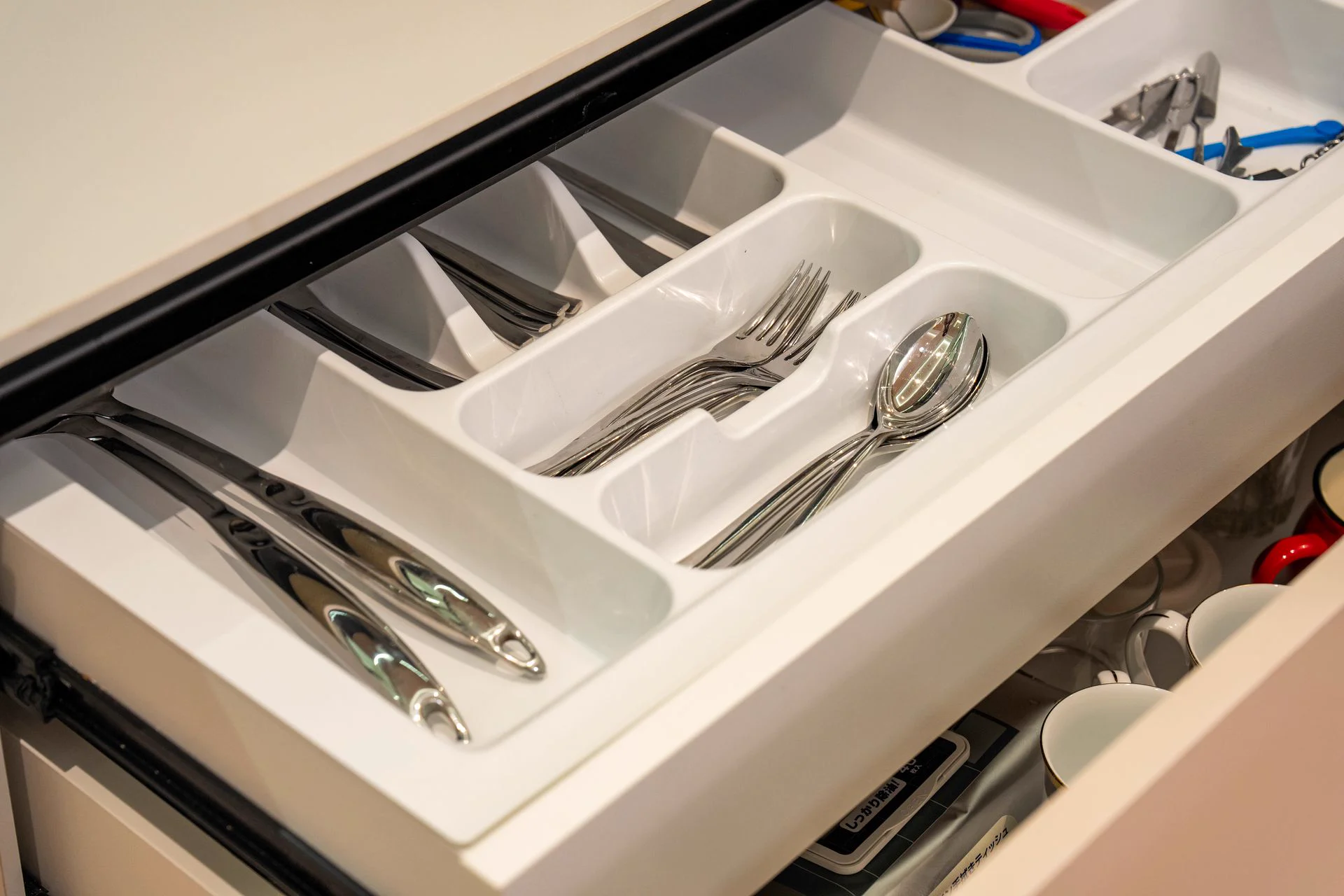
2. Drawer inserts for cutlery, utensils and spices
Drawers are the easiest storage in the kitchen, because the whole drawer comes out toward you and you look down into it. Then the utensils pile up and the spatula slides under the whisk. Cutlery, utensil and spice inserts give each thing a slot.
The spice insert is the one to think about. A lot of kitchens keep spices in the upper cabinet over or beside the stove, which can mean reaching up past a hot burner. Spice jars lying in a drawer insert, labels up, put them just below the counter to the side of the stove. Pick the drawer nearest the stove for spices and the one nearest the dishwasher for cutlery, so the unloading walk is two steps.
3. A trash and recycling pull-out next to the sink
A trash pull-out puts the bins on a frame inside a base cabinet, in most kitchens the one beside the sink. You pull the door or the front, the bins slide out, and you drop the scraps in from standing height. No bending to a can under the sink.
Put it on the side of the sink where you scrape plates. Two bins side by side handle trash and recycling. If the cabinet you'd use is the sink base itself, look at its floor first. A sink base with soft or swollen wood needs fixing before anything slides out of it, and what a slow leak does to the cabinet under your sink shows what to check.
4. A pull-out pantry for the cans you can't see
The cans and boxes at the back of a deep pantry shelf are the ones that expire. A pull-out pantry puts the shelves on slides inside a tall cabinet, so the whole shelf comes out into the room and you see every row from the side.
Use the middle shelves, chest to waist high, for what you open every week: coffee, cereal, canned soup. Put the case of paper towels and the extra flour on the bottom, and the things you buy once a year on top.
5. A lazy Susan or swing-out for the corner cabinet
The corner base cabinet is the worst cabinet in most older kitchens. The opening is narrow, the box runs back into the corner where two runs of cabinets meet, and the far end of it is out of reach for most people. That's where the big stockpot ends up.
A lazy Susan puts round shelves on a spindle, so you turn what's in the back around to the front. A swing-out pulls shelves out of the opening and swings them toward you. Which one fits depends on the shape of your corner box, and the design consultant recommends the one that fits.
6. Soft-close hinges and slides, and pulls you can grip
Our cabinets come with soft-close hinges and full-extension soft-close drawer slides. Full extension means the drawer comes all the way out of the box, so the back of it is as easy to get to as the front. Soft-close means a door or drawer you push shut slows itself near the end and closes without a bang. On our cabinets the hinges adjust six ways.
The pulls matter as much as the slides. The federal accessibility standards say controls in public buildings should work with one hand, without tight grasping, pinching or twisting of the wrist. Those rules aren't written for houses, and they're a fair test for your own hands on a cold morning. A bar pull you hook your fingers through passes it. A small round knob on a heavy drawer full of pots is harder. Our pulls and knobs come in finishes that match the faucet and the lighting.
7. Upper cabinets: what goes on the shelf you can reach
In most kitchens the uppers have fixed shelves, so the organizing here is about what goes where. The federal accessibility standards put the high limit for an unobstructed forward reach at 48 inches above the floor, and the low limit at 15 inches. Reaching over a counter deeper than 20 inches, the same standards drop the high limit to 44 inches. Those numbers are written around a person using a wheelchair in a public building, and they're still a useful yardstick at home. Measure each shelf in your uppers from the floor.
Then sort:
- The lowest shelf of the uppers: the glasses, plates and mugs you use every day.
- The middle shelf: the things you use every week.
- The top shelf: the things you use a few times a year.
- The cabinet over the refrigerator: the Thanksgiving platter and nothing you need on a Tuesday.
- Anything heavy: down to a pull-out or a drawer, not up.
The shelves in our cabinet boxes are 3/4-inch and adjustable, so the lowest shelf in an upper can come down a hole or two to sit where your hand lands. If a shelf you use every day still needs the step stool after the sort, that's the cabinet to talk about with the consultant.
Which organizer fixes which problem
| What bothers you | The organizer | Where it goes |
|---|---|---|
| Kneeling for pots and bowls | Pull-out shelves | Base cabinets |
| Digging through a drawer | Cutlery, utensil and spice inserts | Drawers by the stove and dishwasher |
| A trash can on the floor | Trash and recycling pull-out | Base cabinet beside the sink |
| Lost cans at the back | Pull-out pantry | Tall pantry cabinet |
| The dead corner | Lazy Susan or swing-out | Corner base cabinet |
Whether to add organizers or start over
We fit these organizers into new cabinets or the ones you have. If your boxes are sound and you like the layout, organizers plus refacing (new doors, drawer fronts and veneer on the boxes you keep) gets you a kitchen that looks new and works better without tearing the cabinets out. The five-minute check of your cabinet boxes tells you whether yours qualify. If the sink base is soft or the layout fights you every day, new cabinets are the better call, and the organizers go into those.
The kitchen is one half of staying in the house. The other half is the bathroom, and the same rule applies there: do the work before anyone needs it, on your schedule. A bathroom plan for the next 15 years runs through it in stages.
How Bulldog fits organizers into your kitchen
We design and install cabinets and organizers with our own crews, along with countertops, backsplashes, sinks and faucets, and one team handles all of it. The cabinets and organizers page shows the door styles, the boxes and the organizers we fit. Every job gets a design consultant and a dedicated project coordinator, and our installers are background-checked. The same crew that comes out at the start is the crew that installs. Many kitchen updates take a few days, not months.
At the consultation, open every cabinet with the consultant standing next to you and say what bothers you about each one. "I kneel for this." "I need the stool for that." If your son or daughter is the one who sent you this, have them there too, since they'll be the ones reaching into these cabinets at Thanksgiving.
We don't post prices for kitchen work. The number depends on how many cabinets get organizers, which ones, and whether the boxes stay or get replaced. A consultant measures your kitchen and gives you a written quote. Financing is available on approved credit, and the financing page has the details. Homeowners 65 and older get a discount, and the design consultant has the details. The work carries our lifetime warranty on products and workmanship, for as long as you own the home.
Before the consultant comes, take a sticky note and put one on every cabinet you kneel for or climb to. Call (513) 657-3750 or use the estimate form, and start with the cabinets that have a note on them.
A new-looking kitchen in days, not months walks through every part of the kitchen in order: what to keep and what to replace.