Key takeaways
- Two-tone cabinets have been around for decades; what dates a kitchen is the color of the moment, not the split.
- The splits that age well follow how the kitchen is built, with the island as its own piece or the lower cabinets darker than the uppers.
- Splits that cut one run in half or put the trend color on the biggest surface tie the room to a year.
- Keep the main cabinets white, off-white or wood, and put the bolder color on the island, which usually has fewer doors to change later.
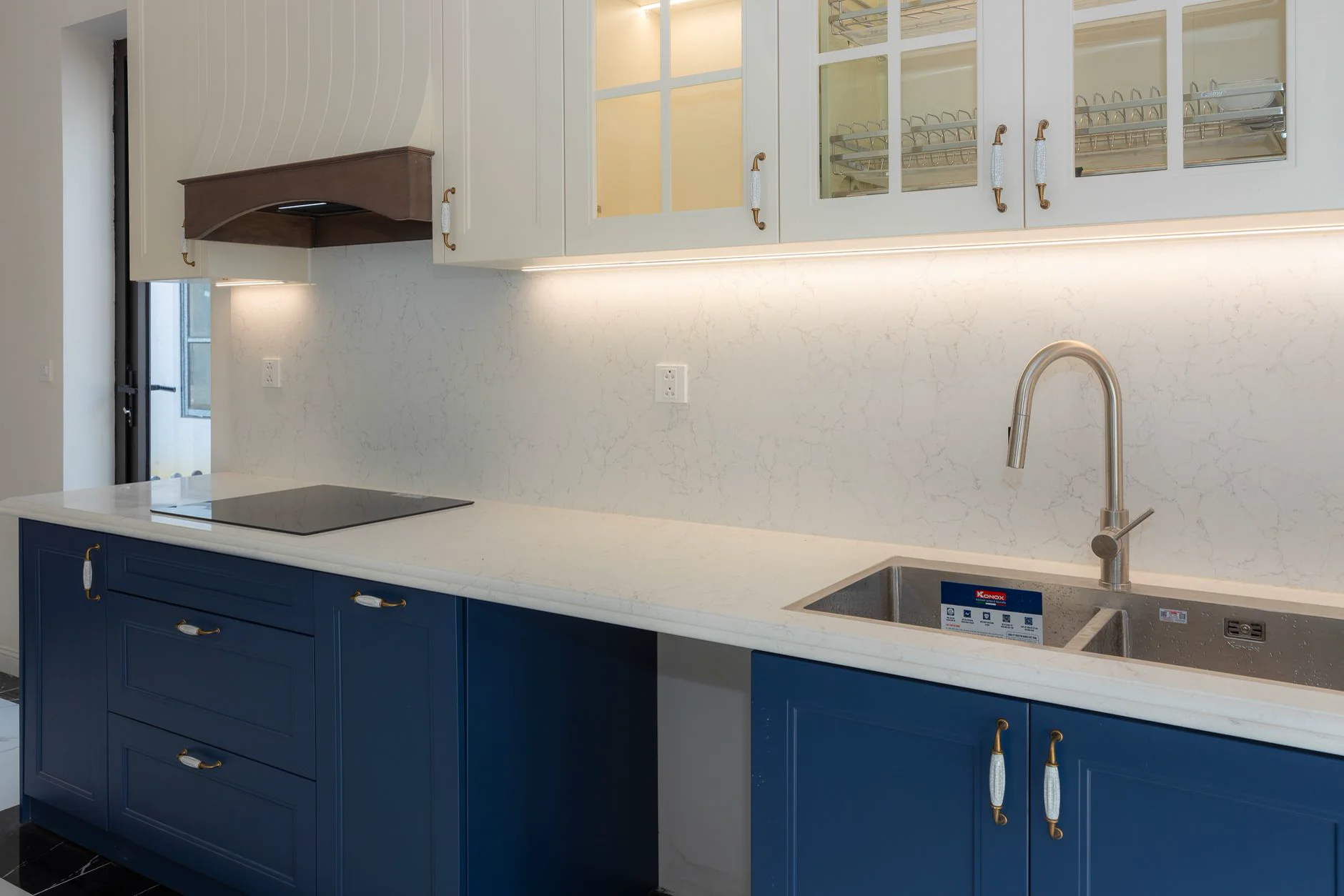
Your daughter sent you a photo of a kitchen with white uppers and navy lowers, and you liked it more than you expected to. Then you remembered the harvest gold range your mother had, and the hunter green everything from the 1990s, and you wondered whether two-tone kitchen cabinets are the next thing you'll be embarrassed by in 2040. It's a fair worry. Our answer, after a lot of Cincinnati kitchens: two-tone is not the trend. The color is. Pick the split for how your kitchen is built and keep the trend color on the smallest piece, and the kitchen holds up.
The split isn't new, the colors are
A farmhouse kitchen with a wood work table in the middle of painted cabinets is the same idea as an island in its own color, and nobody calls that a fad. A kitchen dates when it carries a color that was everywhere for five years and then nowhere.
The numbers show which colors move and which sit still. The 2023 Houzz Kitchen Trends Study, an online survey of 3,627 Houzz users with a kitchen remodel done, under way or planned, found white on the main cabinets at 40 percent, against 41 percent in each of the two studies before it. Wood tones came in at 24 percent in the same study, up 3 points from 2022 and back to their 2021 level.
The island colors moved more in a single year. Among the 46 percent of homeowners who gave the island a color that contrasts with the main cabinets, Houzz found blue dipped to 24 percent from 26 and gray fell to 15 percent from 18, while dark wood went to 11 percent from 6, all between the 2022 and 2023 studies. White on the main run barely moved, and wood came back to its 2021 level. The accent color is the part that turns over.
Houzz is a survey of its own users, people already planning a remodel, so read it as a picture of what renovating homeowners pick, not as a forecast. It still tells you where to put the color you might tire of.
Two-tone kitchen cabinets that tend to age well
These follow the way the kitchen is put together, so they still make sense after the color has gone out of fashion.
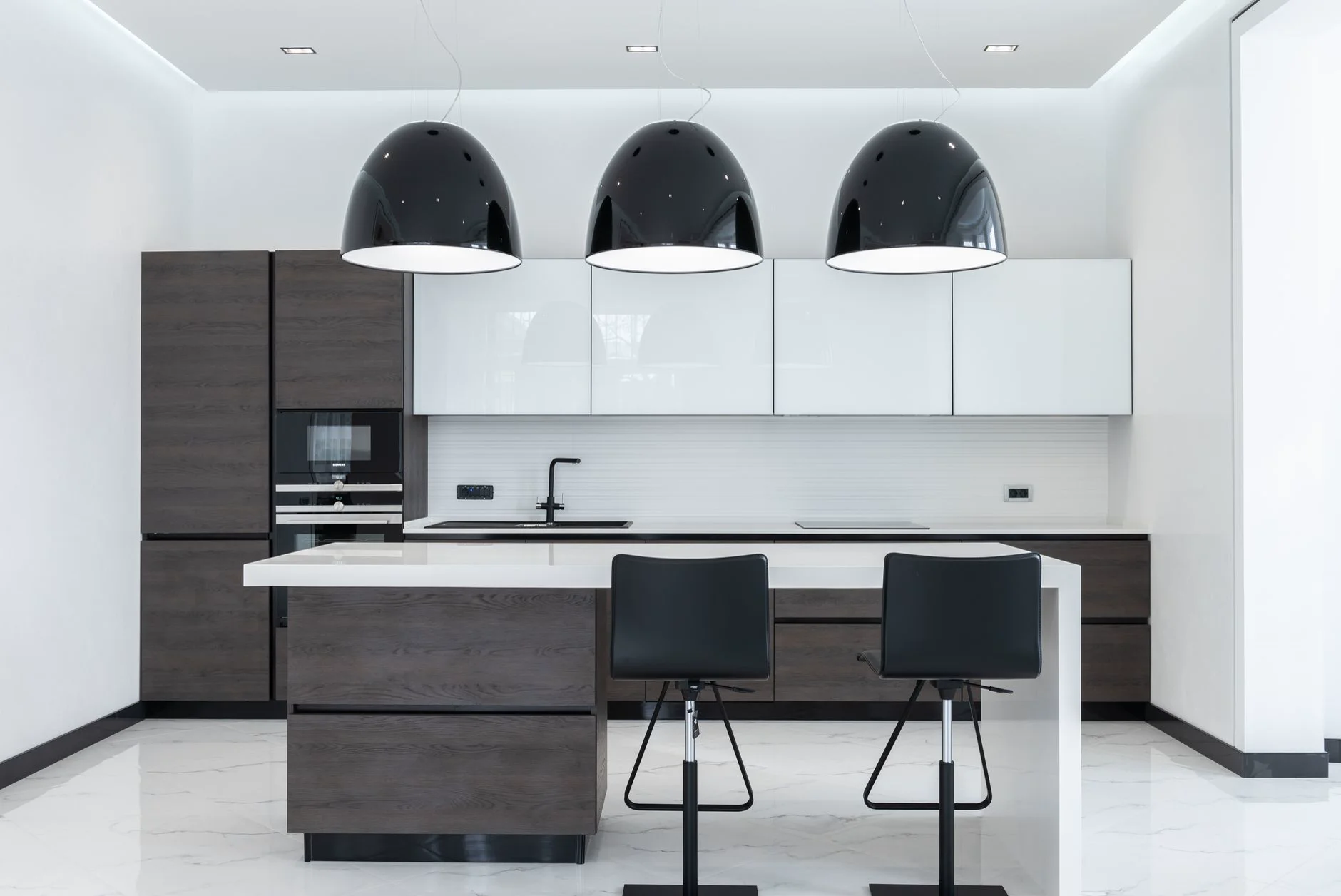
An island in a different color from the main cabinets. The island stands on its own in the room, so a different finish reads as a piece of furniture, the same way a wood table in a white kitchen does. It usually has fewer doors than the cabinets around the walls. If the blue looks tired in 15 years, the island is a short list of doors to repaint or replace, and the perimeter cabinets never need to change.
Darker lowers under lighter uppers. A room tends to look settled when it's heavier at the bottom: dark floor, lighter walls, lightest ceiling. Dark base cabinets fit that order, and white wall cabinets keep the top of the room open. There's a practical side too. The base doors take the kicks, the chair backs and the vacuum, and the painted vs stained cabinets post goes through why a stain or a deeper color on the lowers hides that wear better than white.
Wood with white, either way round. A stained island in a white kitchen, or stained lowers under white uppers, pairs white and wood, the two main-cabinet finishes in the Houzz numbers above. That's the lowest-risk two-tone there is.
Two-tone splits that tie a kitchen to a year
The trend color on the main cabinets. Navy or sage on every door in the room is the same bet as an all-gray kitchen. If you love it in 20 years, fine. If not, you're changing the whole kitchen, not an island.
Dark uppers over light lowers. It flips the order above, puts the heavy color at eye level and makes the ceiling feel lower. In a small kitchen it closes the room in.
One wall one color, the next wall another. A split that runs corner to corner, with no reason in the cabinets to explain it, looks like two jobs done at different times.
Three finishes. White uppers, blue lowers and a wood island is one finish too many for most kitchens. Two colors and the countertop is plenty.
| Split | How it tends to age | Where it fits |
|---|---|---|
| Island in its own color, white or wood perimeter | Well; the color sits on the fewest doors | 1990s open kitchens with an island |
| Darker lowers, lighter uppers | Well; follows the room's light-to-dark order | Small 1960s ranch kitchens, galleys |
| Wood and white, either way | Well; pairs the survey's white and wood main finishes | Almost any house |
| Trend color on the whole perimeter | Dates with the color | A kitchen you'll change again in 10 years |
| Dark uppers over light lowers | Dates and closes the room in | A poor fit in a small kitchen |
Two-tone in a small 1960s ranch kitchen
The kitchen in a 1968 ranch in Anderson Township or Madeira is usually an L or a galley, with wall cabinets on most of the walls and one window over the sink. Many don't have room for an island. Here the split is upper and lower, and the uppers do most of the work, since they're the doors at eye level.
Keep the uppers white or a pale off-white and put the color or the stain below the counter. The room stays as light as it is now, with a bit more weight at the floor. A deep color on the uppers in a kitchen this size makes it feel like a hallway.
Use the same door style on both. If the boxes are sound, refacing gets you there with new doors and drawer fronts in two finishes on the cabinets you already have. A shaker door in white above and the same shaker door in a medium stain below reads as one kitchen in two finishes. Mixing a flat door above with a raised panel below reads as two kitchens. Shaker, flat or raised-panel doors covers which style suits a ranch.
Two-tone in a 1990s open kitchen
A 1990s two-story in West Chester or Mason usually has the kitchen open to the family room, often with an island, and oak cabinets to match the oak trim. Here the island carries the second color. It's also the side of the kitchen you see from the sofa, so the island's back panel is part of the family room. Pick its color with the floor, the fireplace and the furniture in mind, not only the kitchen.
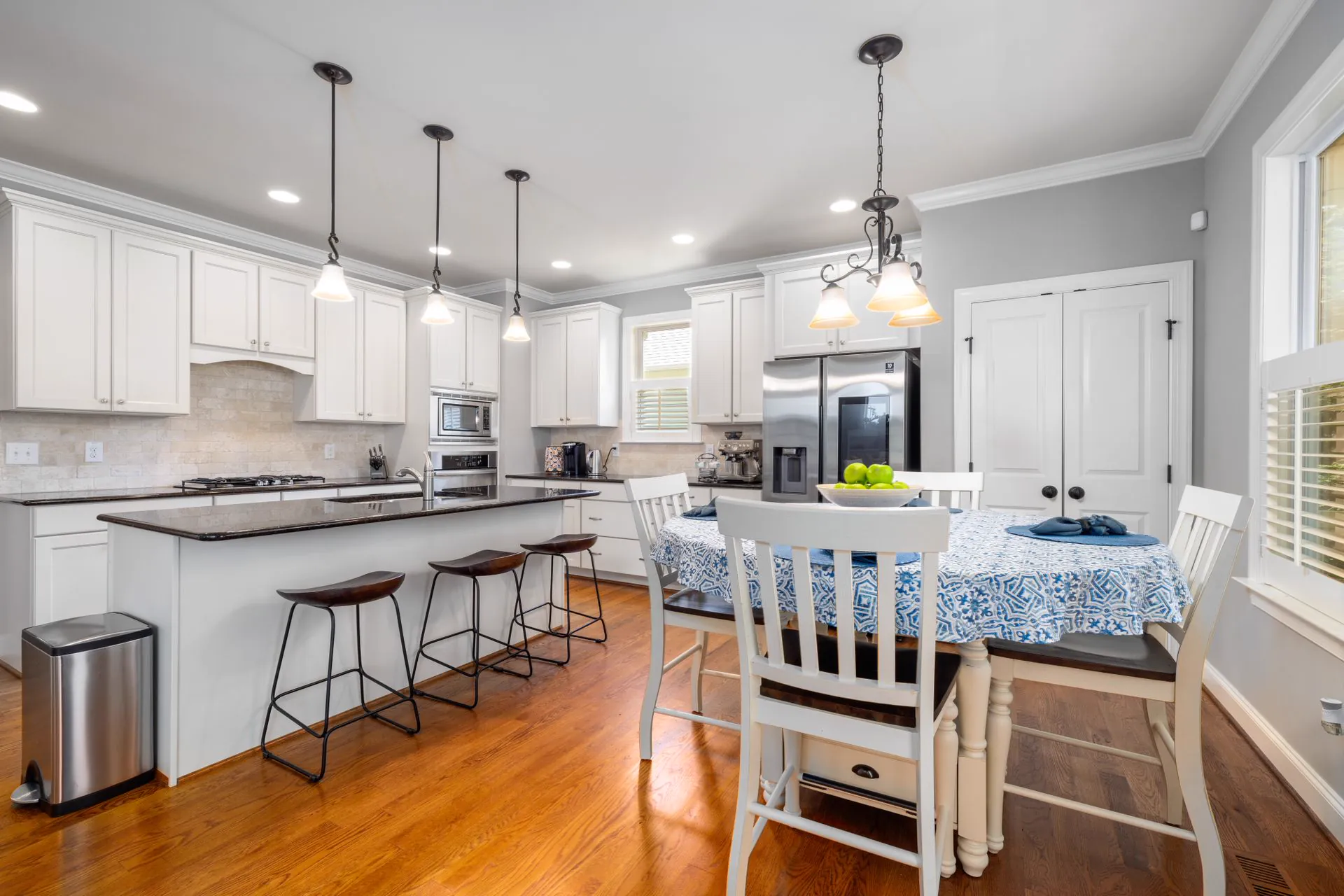
A white or off-white perimeter with a stained or darker painted island is the version we'd pick for most of these houses. It takes the orange out of the room and keeps some wood in it. If the oak trim is staying, a medium-brown stained island ties the kitchen back to the trim better than blue does.
Choosing the two colors in your own light
Pick both finishes standing in your kitchen, at the time of day you cook. A white that looks clean under showroom lights can turn gray or yellow next to a north window, and the second color changes with it. Our design consultant brings samples of colors and finishes to your house, so you can see both in your own light.
If one of the two is stained wood, expect it to move a little. The USDA's Wood Handbook says wood changes color as it ages indoors, finished or not, with dark wood getting lighter and light wood getting darker. The same handbook puts most of that change at about 2 to 3 months, depending on how much light the wood gets. A stained island next to a sunny window can drift a shade from the sample. Leave some room between the two colors, so a small drift doesn't turn a clear contrast into a near-miss.
Three questions to settle before you pick colors:
- Which piece would you be willing to change in 15 years? That's where the bold color goes.
- Is there an island, or is the split upper and lower?
- What else in the room is staying: the floor, the trim, the countertop? The two cabinet colors have to sit with all of it.
Two-tone cabinets from Bulldog
Bulldog offers shaker, flat-panel and raised-panel doors in painted, stained and two-tone finishes, with full cabinet replacement or refacing. If your boxes are solid, refacing puts new doors, drawer fronts and veneer on them, and the boxes stay on the wall; can my cabinets be refaced? walks through a five-minute check. If they're worn or damaged, we replace them.
On the new cabinets we install, the plywood boxes are finished on the outside to match the door. In a two-tone kitchen, ask the design consultant to walk you through how the exposed ends of the island are finished. The doors are 3/4-inch solid wood with a 12mm MDF center panel on a solid hardwood face frame, with soft-close hinges and drawer slides, as the cabinets page shows.
You see cabinet colors in person during the design consultation, so you can hold the two finishes up against your own floor and counter. The consultant measures and gives you a written quote. Many kitchen updates take a few days; a full kitchen with new cabinets takes longer, and your project coordinator gives you a schedule before work starts. The products and the work carry a lifetime warranty for as long as you own the home, and financing is available on approved credit.
If you're stuck between two pairings, call (513) 657-3750 or request an estimate and ask the consultant to bring samples of both.
A new-looking kitchen in days, not months walks through every part of the kitchen in order: what to keep and what to replace.