Key takeaways
- An older laminate countertop is a thin plastic sheet glued to a particleboard core, so a burn goes through the pattern and water at the sink seam swells the board underneath for good.
- A small burn or one lifted edge can be patched, but a swollen seam by the sink means the core has taken on water and the top is near the end.
- Replacing it means the old top and its backsplash come off, the new top is templated and cut to fit, and the sink and faucet are reset.
- Bulldog installs quartz, granite and solid surface, and a consultant measures and gives a written quote.
The countertops in your kitchen went in with a remodel around 1990, a speckled beige laminate with a rounded front edge and a short backsplash built onto the back. They've held up. There's a brown ring next to the stove where a pot went down hot one Thanksgiving, and the seam in front of the sink has a ridge you can feel with your thumb. Neither one is an emergency. They do tell you what the top is made of and how much life is left in it, and that is what decides whether you patch it or replace it.
What's under a laminate countertop
A laminate top is two things glued together. The face is a sheet of plastic laminate: printed paper soaked in melamine resin and pressed over layers of resin-soaked kraft paper. Wilsonart's data sheet for its countertop laminate lists a thickness of 0.039 inch, a little thicker than a credit card. The same sheet says the laminate isn't structural and must be bonded to a substrate such as particleboard, medium density fiberboard or plywood.
In many older kitchens, that substrate is particleboard: wood chips pressed together with glue. It's also the reason the top fails where it does. The laminate face handles a wet sponge fine. The board under it doesn't like water at all.
The burn mark next to the stove
A hot pan burns a laminate top because the pattern is a printed layer close to the surface. Wilsonart's data sheet says not to expose its laminate to temperatures higher than 275°F for substantial periods, and its care guide says a pot straight from the oven or burner can cause cracking or blistering. A blister is the glue under the laminate letting go.
You can't sand a burn out the way you would on a wood table, since the color sits in that thin printed layer and there's particleboard right under it. The repairs that exist cover the spot: a fill product on a small mark, or a cutting board or trivet set into the counter over a bigger one. If the burn is the size of a quarter and the rest of the top is sound, set a trivet over it and keep cooking. It's not a reason to replace a countertop on its own.
The swollen seam by the sink
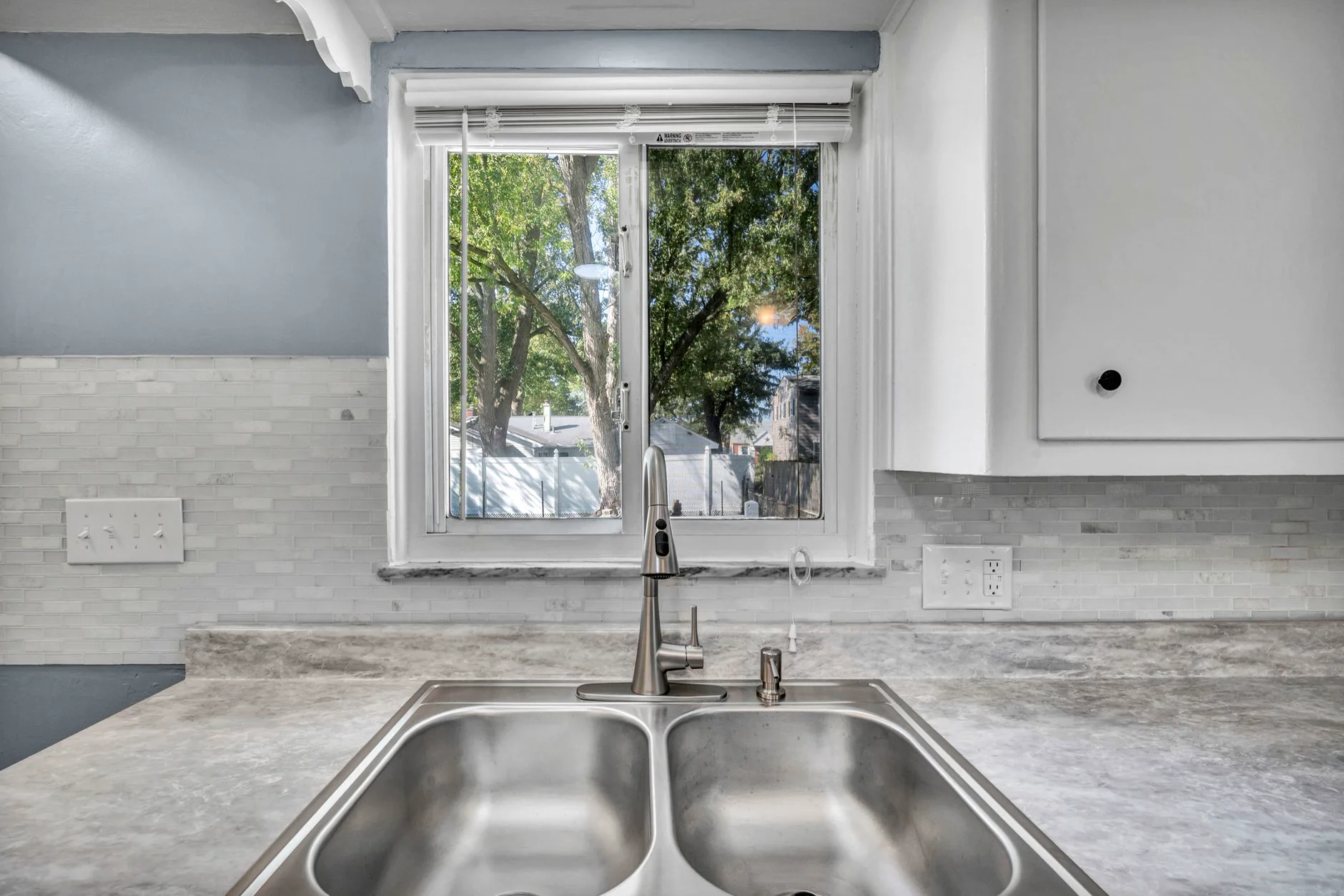
The ridge at the sink seam is a different problem. A seam is where two pieces of countertop meet, and on many L-shaped kitchens one lands near the sink. Water from the faucet and the dish rack sits on that joint, and once the sealant in it wears, water gets to the raw edge of the particleboard. The sink cutout is the other weak spot: the edge under the sink rim is raw board too.
Particleboard swells when it takes on water, and not all of it shrinks back. In a Forest Products Journal study of commercial particleboards, boards cycled between dry and damp air swelled 5.5 to 15 percent in thickness, and a third to a half of that swelling stayed after they dried. A countertop seam that gets splashed every day goes through that cycle over and over. The ridge you feel is the board pushing the laminate up.
Before you decide anything, open the cabinet under the sink with a flashlight. Look up at the underside of the countertop around the sink and at the cabinet floor. Dark, soft or crumbling board under the top, or a soft cabinet floor, means water has been getting in for a while. The soft floor under your kitchen sink walks through finding the leak and checking the sink base.
When patching the old top still makes sense
Laminate is a fair countertop, and a sound one is worth keeping. Patching makes sense when:
- The damage is one burn or one chipped edge, and the rest of the surface is flat.
- The seam is tight and dry, with no ridge.
- The board under the sink is firm and dry.
- You like the layout and the color doesn't bother you.
A swollen seam, a lifted edge that won't stay glued, or soft board around the sink points the other way. Those point to water in the core, and no patch on the face fixes the core. At that stage you're choosing a new countertop, and the question becomes what it's made of.
What replacing a laminate countertop involves
A countertop replacement runs in five steps.
- Measuring and choosing. A consultant measures the kitchen and you choose the material, the color, the edge, the sink and the faucet. You get a written quote.
- Templating. Stone has to be cut to the exact shape of your cabinets and walls. Our team makes a digital template of your existing layout for a tight, accurate fit before anything is cut.
- The old top comes off. A laminate top is held on with screws from underneath, through the corners of the cabinets, and caulk along the wall. The crew shuts off the water, disconnects the faucet, the sink drain and the dishwasher bracket, backs out the screws and lifts the top off with its backsplash.
- The new top goes on. The crew sets the new pieces, joins any seams and mounts the sink.
- Sink, faucet and backsplash. The faucet goes back in, the drain and the dishwasher get reconnected, and the edge along the wall gets finished.
The kitchen sink is out of service for part of the job, and you'll want the counters clear and the cabinets under the sink emptied before the crew arrives. Countertop work is done in days, not months, and your project coordinator gives you the dates before anything starts.
The sink and faucet
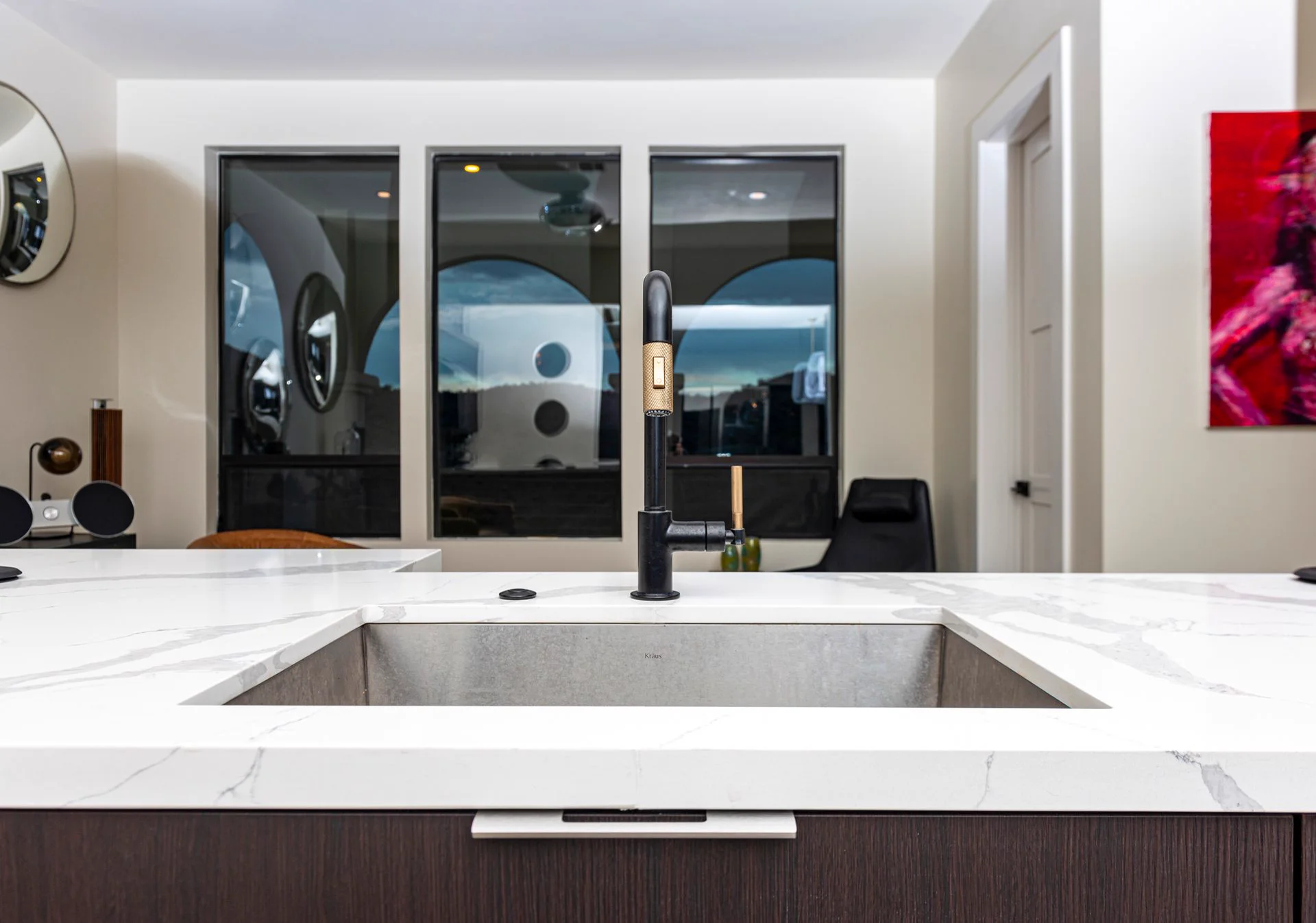
Many laminate kitchens have a drop-in sink, the kind with a rim that sits on top of the counter. That rim is part of why the cutout edge stays wet. A stone or solid-surface top can take an undermount sink, mounted under the counter so you can wipe crumbs straight into it. Bulldog's tops come with undermount sink cutouts, and a drop-in sink is an option too if you'd rather keep that style.
The faucet is a choice too. A new stone top gets its faucet holes drilled to match the faucet you pick, so this is the easy time to change it. If your current faucet is newer and you like it, ask whether it can go back on.
The backsplash edge
On many old laminate tops the short backsplash is part of the countertop, and it comes off with it. Behind it you'll find a strip of wall that's never been painted, and sometimes torn drywall paper where the caulk let go. Something has to cover that line.
You can go one of two ways. A short splash in the countertop material covers the strip, and you repaint above it. A full backsplash up to the upper cabinets covers the whole wall. Bulldog installs ceramic, porcelain and glass tile, natural stone, mosaics and grout-free panels for that. Decide this at the measuring visit, since it changes what gets ordered.
Quartz, granite or solid surface
Bulldog installs three countertop materials: quartz, granite and solid surface. We don't install laminate. If a new laminate top is what fits your plans, that's a reasonable choice, and a home center can order one.
| Material | What it is | Heat | Upkeep and repair |
|---|---|---|---|
| Quartz | Engineered stone made with resin | Less heat-resistant than granite; use a trivet | No sealing |
| Granite | Natural stone slab | Handles hot pots | Sealing optional; most granite doesn't need it |
| Solid surface | A solid sheet with the color all the way through | Needs a trivet with legs | Minor scratches buff out; a fabricator can renew it |
The Natural Stone Institute's consumer site says engineered quartz does not require sealing and is less heat-resistant than natural stone, and that granite handles hot pots and pans. The Institute's position is that most granite countertops do not need to be sealed, though a sealer adds stain resistance. Wilsonart's solid surface guide says the material is renewable because the color goes all the way through, and asks for a trivet with legs under hot pans and appliances.
For a couple who cooks every day and leaves the pot on the stove, granite or quartz are the usual picks. Solid surface suits a kitchen where a top you can buff back up after years of scratches matters more than setting a hot pan down.
The cabinets under the new top
A stone top is heavier than particleboard and laminate, and it sits on whatever boxes are already there. Ask the consultant to look at the cabinets at the measuring visit. A soft sink base or a box pulled loose from the wall needs fixing before a stone top goes on. If your doors are tired too, a five-minute check of the cabinet boxes tells you whether they're solid enough to reface, and new doors and a new top can go in on the same job.
What sets the price
We don't post countertop prices, because the measurement sets them. The things that move the number:
- The square footage of the top and how many pieces it takes.
- The material and the color you choose.
- The edge profile and the sink cutout.
- The backsplash: a short splash, a full wall or none.
A consultant measures and gives a written quote. Financing is available on approved credit, and the quote is free.
If your top has one burn ring and a dry, flat seam, put a trivet over the ring and keep it. If the seam by the sink has a ridge and the board underneath is soft, look at the colors and edges on our countertops page, then call (513) 657-3750 and we'll come measure.
A new-looking kitchen in days, not months walks through every part of the kitchen in order: what to keep and what to replace.