
Key takeaways
- Bulldog does not post prices because five things set the price of a one-day shower: the size of the tub or shower area, the base, the door and glass, the fixtures and wall pattern, and what the crew finds under the old tub.
- A free in-home estimate gets you a written quote.
- Compare quotes line by line, and ask each company what happens to the price once the wall is open.
You have a 1994 two-story in West Chester, a master bath with the builder's tub-shower combo and a cultured-marble surround that has gone the color of weak tea, and a plan to list the house in two or three springs. You typed "one day bathroom remodel cost Cincinnati" because you want a number before you let anyone in the door. The number does not exist yet. Five measurements set it, and the same five tell a good quote from a thin one.
Bulldog does not post job prices. The price of your shower comes from measuring your shower, and a design consultant does that in your bathroom and leaves a written quote. The visit and the quote are free. The consultant looks at five things while they measure, and those five are the sections below, so you can judge any quote you get, ours included.
What a one-day bathroom remodel price covers
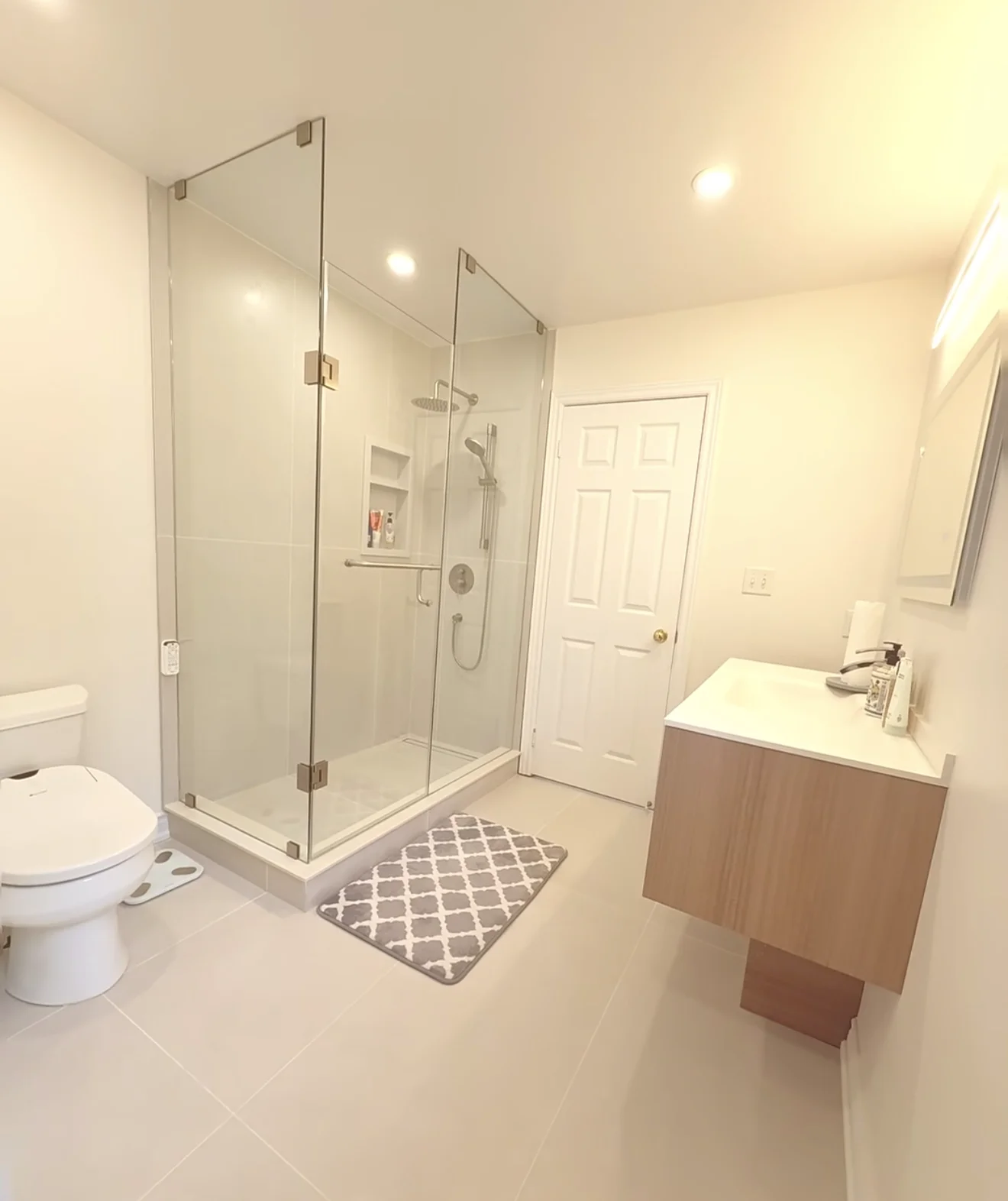
The one-day job is the tub or shower and its three walls. The crew takes that area to the studs, old tub and tile out, then rebuilds it with a new base, solid-surface walls fabricated to the measurements from your consultation, the valve (the part in the wall that mixes hot and cold; the handle you see is the trim), the door and the shower head. By evening it is in, and you take the first shower the next morning once the caulk has set.
The floor, the vanity and the toilet are not in that number. If you want them done too, the consultant says so at the estimate and tells you it runs longer than a day. Quotes from other companies may or may not draw that line, so when you compare, start by asking each one what its number covers.
Price factor 1: the size of your tub or shower
The first thing the consultant writes down is the size of the alcove. Most tub-shower combos in a 1990s two-story sit in a 60-inch opening with walls about 8 feet high, and the wall system is made to those numbers. A tub that is longer, a shower that runs to the ceiling, a half wall that needs capping, or a window inside the wet area all add material and labor, and the quote goes up with them.
Whether you keep a tub or go to a shower matters here too. A tub-to-shower conversion means the crew sets a shower base where the tub was and often moves the drain to suit it. Replacing a tub with a tub keeps the drain where it is. Neither is the lower number by default; the base you pick decides more than the choice between them.
Price factor 2: the shower base you choose
The base is the floor of the shower, and four kinds show up on our quotes: a standard curbed base you step over, a low-threshold base you step across, a base with a built-in seat, and a neo-angle corner base for a corner shower. The slip-resistant textured floor is available on them.
The low-threshold base and the seat cost more than the standard curb, and they are the two that homeowners in Anderson Township and Fort Thomas, Kentucky ask us about most when they plan to stay in the house. A seat built into the base reads as a shelf from the doorway and is easier to put in now than to add in ten years. If the consultant's quote has a line for the base, ask which one it is and what the other three would do to the number.
Price factor 3: the shower door and glass
A curtain rod is the least expensive way to close a shower. After that come a sliding bypass door, a hinged door, and a frameless door, in that order from least to most. The glass itself comes in three thicknesses, 1/4 inch, 5/16 inch and 3/8 inch, and a frameless door needs the thicker glass to stand on its own.
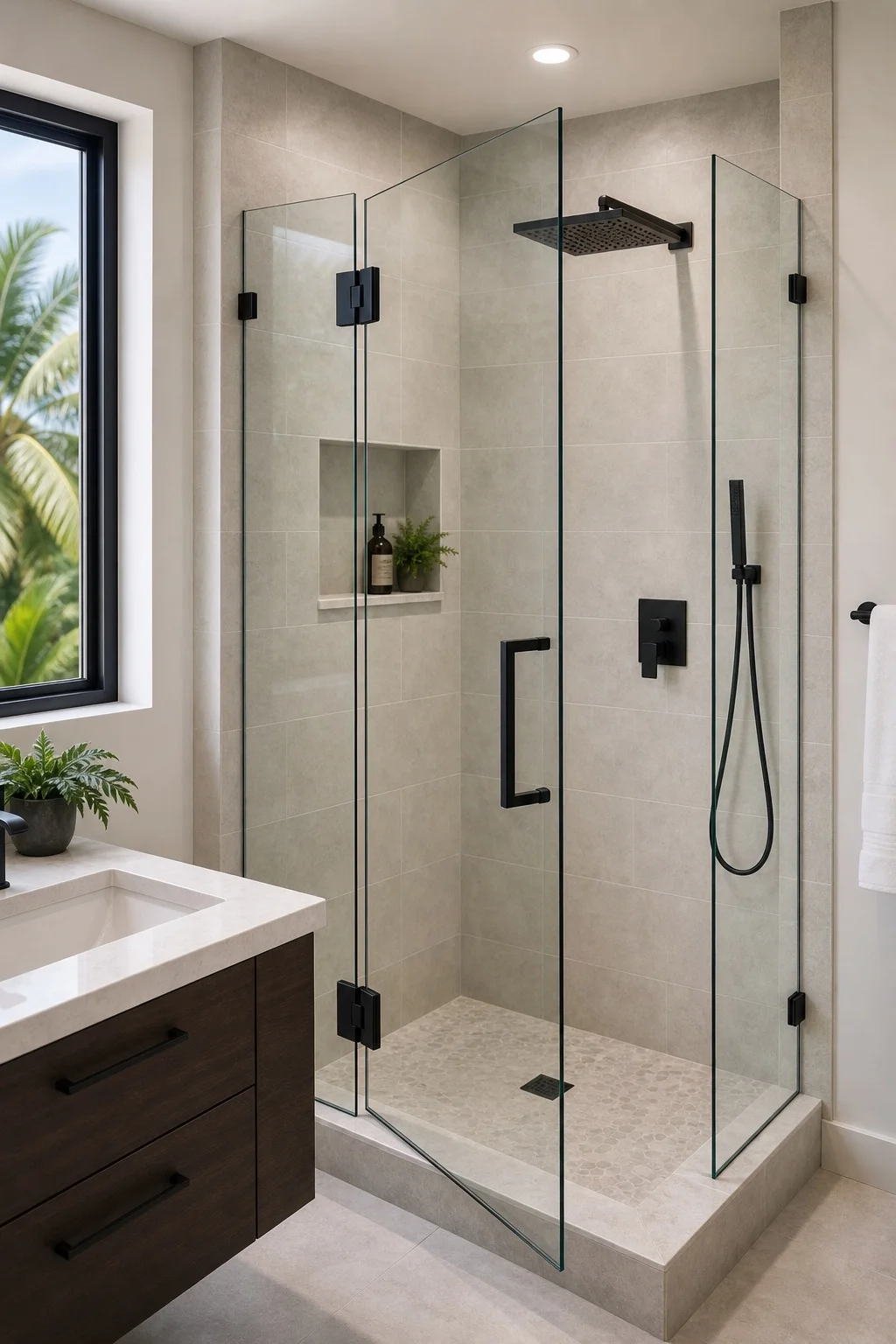
Then the finishes: clear, rain, frosted or corrugated glass, etched patterns on most of them, and hardware in matte black, brushed nickel, oil-rubbed bronze or chrome. A frameless door in 3/8 glass with matte black hardware is the one people photograph. It is also one of the lines that moves most when you change it, so if two quotes are far apart, check the door before anything else.
Price factor 4: fixtures, niches and wall patterns
The valve and trim, the shower head, and anything built into the wall go on this part of the quote. A rain head plus a handheld on a slide bar costs more than one fixed head. A recessed niche or a set of corner shelves is cut into the wall system before install day, so it is its own line on the quote.
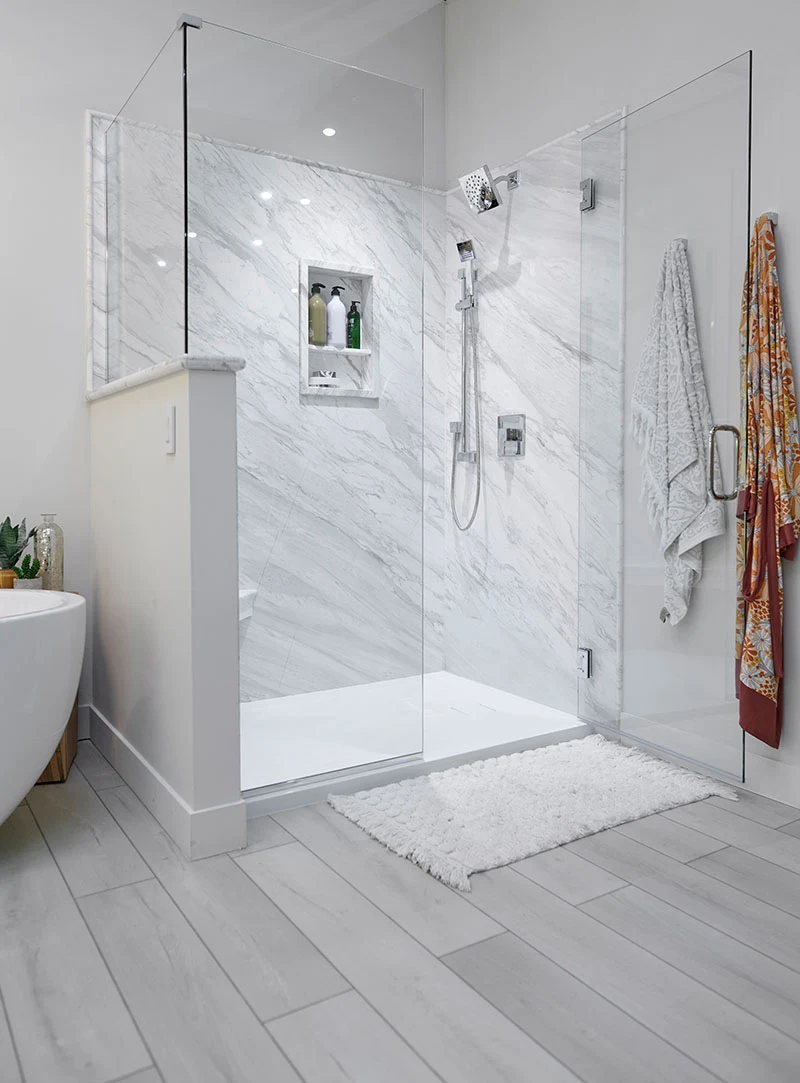
The wall pattern is on this part of the quote too. Most of our customers land on the marble or travertine looks, and the tile-look patterns (subway, herringbone, hexagonal, picket) are cut into the same non-porous panel, with the look of grout lines and nothing to scrub. Ask the consultant whether the pattern you like changes the number; the answer depends on the product line, and it belongs on the page before you sign.
Price factor 5: what is under the old tub
The part of the price you cannot see from the doorway is also the part a phone call cannot give you. The median home in Hamilton County was built in 1963, and about seven in ten were built before 1980, according to the Ohio Department of Development's 2025 county profile. Behind the tile in a house that age our crews often find a damp patch of subfloor by the drain, dark drywall behind the bottom rows, a galvanized supply line, or a valve older than the one the consultant expected. A 1994 house is younger, and the cultured-marble surround over drywall has had thirty years of water finding the seam at the tub ledge.
Contractors split on how they handle it, and the split is where a low quote gets expensive. Some write subfloor repair and plumbing into the number before you sign. Some leave it out and send a change order the morning the tub comes out. Ask each company, in writing, how it treats what the crew finds behind the wall, and ask our consultant to show you where it sits on our quote. We wrote up what the crew does with those finds, hour by hour, if you want the whole day.
What a low quote tends to leave out
If one number on the table is far below the others, the gap is most often something the low quote left out. Check for these before you compare totals:
- Demo and haul-away. Getting a cast-iron tub out of a second-floor bathroom and down to the truck is real work, and some quotes bill it as an extra.
- Subfloor and plumbing. Covered above. If the quote does not mention them, they are not in it.
- Mold and mildew behind the tile. Ask whether cleaning and treating the framing is part of the job or a separate charge.
- Permits, if your job needs one. Ask who pulls it and whether it is in the price.
- Who installs. A quote built on the company's own crew and a quote built on subcontractors are two different numbers, and the warranty on the work follows whoever did it.
- The warranty itself. A manufacturer's warranty on the panels and the installer's warranty on the work are two documents. Ask for both.
The Ohio Attorney General's consumer office advises homeowners to get written estimates from several contractors, to make sure the oral promises are in the written contract, and to be cautious of a contract that asks for a large down payment. A contract signed in your home also carries a three-day right to cancel under Ohio law, and the contractor cannot start work until that period ends.
How to compare two bathroom remodel quotes
Put the quotes on the kitchen table and go line by line before you look at the totals. Write on the back of each one: what size alcove it covers, which base, which door and glass, which fixtures, and the one-sentence answer to "what happens to this number once the wall is open." Then compare the warranty pages and the install schedule, since a shower that costs less and takes three weeks is a different purchase from one that is in by evening.
If you are in West Chester with a listing planned, the schedule and the change-order answer protect your timeline, and a new non-porous shower with nothing to regrout is one less line in a buyer's inspection report. If you are in a 1968 ranch in Anderson Township and plan to stay, the base and the warranty are the lines to weigh, because you are the one who will use that shower for the next twenty years. Our tile vs. solid-surface comparison covers the twenty-year side of that in more detail.
Financing a one-day shower: as low as $150 a month
With promotional financing, qualified buyers get the shower area gutted to the studs and rebuilt, base, walls, fixtures and the lifetime warranty on the product and the work, for as low as $150 a month, or 12 months no interest on approved credit. The financing page has the current terms, and the consultant goes through the plans at the estimate.
One thing to ask about any no-interest offer, ours or anyone's: whether it is deferred interest. The Consumer Financial Protection Bureau explains that on a deferred-interest plan, interest is set aside rather than waived, and if a balance remains when the promotional period ends, the lender charges the interest back to the purchase date. Their advice is to divide the balance by the number of months and pay that amount rather than the minimum, and to finish a month early. That is good advice on any plan.
Two more things on the money page. Bulldog takes $1,250 off a qualifying full kitchen or bathroom remodel, presented at the estimate and not combinable with other offers. Homeowners 65 and older get a discount the consultant can explain. Promotions change, so check current promos for what is live the week you call.
Getting a free written quote
The consultant measures the tub or shower area, goes through the colors and patterns with you, answers the five sections above for your bathroom, and leaves a written quote. You can take the three business days, and the other two quotes, and compare them line by line.
Call (513) 657-3750 or send us your address and a good time. The estimate is free and the quote is in writing.
One-day shower replacement in Cincinnati puts the whole job in one place: what it covers, what it doesn't, and how to judge a bid.